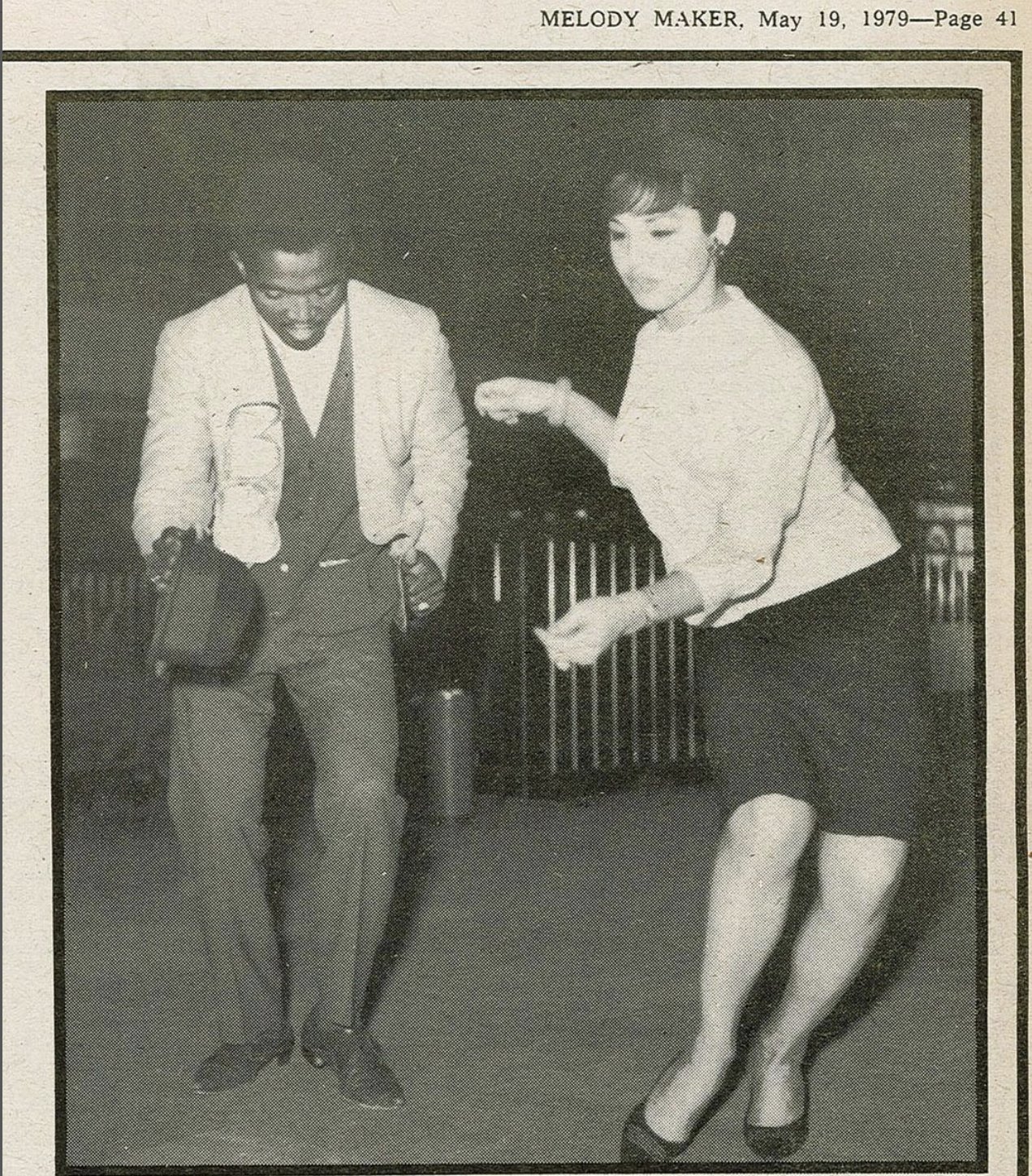
Photo above is of Brigitte Bond (a trans woman) dancing with Ska pioneer Prince Buster in 1964. British band, The Beat used a stylised version of Bond’s dancing as a logo. For more info:
Along with masking and interoception, alexithymia has featured widely in the autistic literature in recent years. I decided to look into the history of this sub-clinical construct after seeing it used as a weapon against both trans and neurodivergent folk in the Cass Review.
Although the autistic autism literature is trans friendly, some of the autistic literature bears an uncanny resemblance to Cass’s account. This is obviously unintentional, but it would be useful to recognise this, in my view, and ask why. There has been an extraordinary explosion of alexithymia appearing in the autism literature. It is in the ever-burgeoning masking literature that an unfortunate congruence with Cass’s account is to be found. Here I am going to look at the Cass Review and the NHS guidelines based upon it. Following that I’m going to give examples of alexithymia appearing in the autistic autism literature. Part 2 will look at the history of alexithymia and how it has often been used to pathologise and engage in testimonial and hermeneutic silencing, and detail its rapid inclusion in everything autistic.
Alexithymia “has its origin in the theoretical bases of the orthodox psychoanalytical model” [López-Muñoz, Pérez-Fernández, 2020]. It is based on the following premises: “1) difficulty in identifying and describing feelings; 2) difficulty in distinguishing between feelings and bodily sensations related to emotional activation; 3) restrained and limited imaginative processes, adopting the guise of an impoverished fantasy; and 4) a cognitive style oriented toward the outside.” [López-Muñoz, Pérez-Fernández, 2020]. These days 1 and 2 are often only employed, although in other accounts 3 and 4 still appear. One can also come across the phrase ‘alexithymic traits’ in the literature.
Here’s the quote from the Cass review that attracted my attention:
“Difficulties with interoception (making sense of what is going on in their bodies) and alexithymia (recognising and expressing their emotions) can sometimes make it hard for these young people to express how they are feeling about their internal sensations, their gender identity and their sexual identity.” [Cass, 2024]
This information appears to have been taken from a discussion about findings in “an audit undertaken at The Tavistock and Portman GDC on the characteristics of individuals who had detransitioned.” The Cass review asked for access to this audit, but this request was declined. [Cass Review 15.56] The quote is interpreted by Carys Moseley of Christian Concern thus. “It appears that this sub-population of children and adolescents are vulnerable due to communication difficulties to misinterpreting their problems as stemming from an unaffirmed transgender identity.” Sex Matters also references the Cass Review explaining that one of the recommendations for those experiencing “genders issues” is “diagnosing autism or ADHD” [Sex Matters, 2024]. “
A proposed lack of knowledge about one’s own emotional states and internal signals has contributed to the pathologisation of those who lie outside of the neuronormative and cisnormative domains.
The NHS gave notice to the “Chief Executives and Chief Medical Officers of the organisations that provide Adult Gender Dysphoria Clinics (GDC) in England” the day before public publication of the Cass Review, “to inform you that NHS England will be launching a review into the operation and delivery of the adult GDCs, alongside the existing planned review of the adult gender dysphoria service specification,” referencing concerns about “individuals with complex co-presentations and undiagnosed conditions.” [Stewart, Palmer, 2024]. Neurodivergent children and adults, it is implied, are not competent to make their decisions about their lived gender identity. They lack the capacity to know who they are.
Alexithymia (and disrupted interoception) is being weaponised against those not neuronormative and/or cisnormative. Those referred to gender services will now be assessed for neurodivergence and mental illness. “Children and young people who are referred for gender incongruence or gender dysphoria show significantly higher than expected levels of: autism spectrum disorder, attention deficit hyperactivity disorder (ADHD), anxiety, depression, eating disorders, suicidality, self-harm, adverse childhood experiences” [NHS England 2025]“Recommendation 2: ensure children/ young people referred to NHS gender services receive a holistic assessment of their needs to inform an individualised care plan. This should include screening for neurodevelopmental conditions, including Autism Spectrum Disorder” [NHS England 2024]
Any parents who access puberty blockers from the EU or other sources are threatened with what is known to many parents of neurodivergent children – safeguarding concerns. “suggest that the GP or local health professional considers what safeguarding protocols may be appropriate for the individual child or young person’s wider circumstances including the extent to which the parents / carers are able to protect or safeguard the child or young person.” [NHS England 2024]
Let’s compare Cass’s account of alexithymia with autistic researchers and writers accounts:
“Around 50% of autistic individuals experience alexithymia, that is, difficulty in identifying and distinguishing personal emotional states from bodily states” [Doherty et al 2025]
“50% of Autistic people are alexithymic Which means that we have difficulties reading, interpreting, or even feeling our emotions. Emotions are an internal sense, this sense is called interoception. When we talk about alexithymia what we are talking about is interoceptive differences specifically related to our experiences of emotion. If we have interoceptive differences, how are we supposed to know which internal authentic expressions we are unconsciously masking?” [Gray-Hammond, blog]
“Masking can also lead to a sense of identity confusion relating to a loss of ‘authentic self’” [Hull. et al, 2022]
“We need to talk about interoception to understand the overlap between autism and alexithymia. Interoception is the link that connects alexithymia and autism. In fact, it may be more accurate to consider alexithymia as an extension of interoception difficulties. When a person has a deficit of interoception awareness, they will also have alexithymia. Alexithymia can be thought of as a byproduct of poor interoception awareness.” [Neff, blog]
“Many autistic people have sensory processing difficulties and may struggle to understand and interpret their internal body feelings (interoception) as well as experiencing difficulties understanding and responding to emotions (alexithymia).” {Autistic Realms, blog]
I would suggest that if autistic researchers and writers choose to include alexithymia in their accounts, they should be very careful to distinguish their accounts from those who use alexithymia as a psychological phishing expedition resulting in malware being downloaded to others’ perception of you, and a political position where one is declared incapable, or too mentally ill, to have any agency when it comes deciding one’s own lived identity.
Traditional autism research, usually called the bio-medical model, abstracts all co-occurring diagnoses/conditions, even though these occur in most autistic people and can often be the cause of more difficulties than being autistic. It researches autism, not autistic people. In the predominant autistic autism research model, the same methodology is used as in the bio-medical model. Again, all co-occurring diagnoses/conditions, have been abstracted. Interestingly, in both these reductive models where an autism diagnosis is superordinate, co-occurring alexithymia has been granted special dispensation and is included in the research. Although alexithymia is usually reported to co-occur in 50% of the autistic population. Sometimes this special dispensation of inclusion is also afforded to ADHD. In these two models, all other co-occurring diagnoses/conditions are effectively rendered psychologically inert by their abstraction. Quite why alexithymia has been granted this special dispensation of inclusion is not explained. There are some neurodivergent researchers and advocates who do place co-occurring diagnoses/conditions in a dialectical/dynamic relationship with being autistic. These accounts also include alexithymia. This will be explored in Part 2.
Why the unhappy coinciding of Cass’s account and autistic accounts? I would point to a number of concerns. Alexithymia is all-pervasive currently in the literature. Everyone has jumped on the alexithymia train. There appears to be no exploration of its history as a deficit model. While it speaks of emotions, it is often referenced with no accompanying theory of emotions/autistic emotions. Knowing/unknowing emotions may be somewhat more complex than knowing/not knowing when to pee. It appears repeatedly in the autistic masking literature. This literature draws heavily on Goffman’s dramaturgy, a tripartite concept (front stage, back stage, the audience). This is an impoverished account of self/identity. The combination of alexithymia, interoception and an incomplete theory of self/identity has coalesced into another deficit narrative, despite intent.
López-Muñoz, Pérez-Fernández, 2020. A History of the Alexithymia Concept and Its Explanatory Models: An Epistemological Perspective
Cass, 2024. Independent review of gender identity services for children and young people: Final report. 5.44
Moseley, 2024. Cass Review: why are children uncomfortable with their sex?
Sex Matters, 2024. How should schools respond to “gender questioning” children?
Stewart, Palmer. Review of NHS adult gender dysphoria clinics. Letter from National Director, Specialised Commissioning, NHS England and Medical Director, Specialised Commissioning, NHS England to Chief Executive and Chief Medical Officers of NHS trusts providing adult gender clinics.
NHS England, 2024. Children and young people’s gender services: implementing the Cass Review recommendations
NHS England, 2024. Guidance To Primary Care About Unregulated Providers Who Supply Hormone Medications To Children And Young People For Gender Incongruence
McGoldrick, Munroe, Ferguson, Byrne, Doherty. Autistic SPACE for inclusive Education
Gray-Hammond, blog. Mask on, Mask off: How the common understanding of Autistic masking is creating another mask.
Chapman, Rose, Hull, Mandy. “I want to fit in… but I don’t want to change myself fundamentally”: A qualitative exploration of the relationship between masking and mental health for autistic teenagers
Neff, blog. Autism and Alexithymia: Similarities, Differences, and Overlap
Autistic Realms, blog. Autism, OCD, Alexithymia & Interoception.